

Austin Commercial Sites helps businesses lease or buy warehouse, flex, and industrial space in Austin, and helps owners lease or sell industrial property. For tenants and buyers, our service typically costs nothing because the landlord or seller pays the brokerage fee. Tristen Palori, a licensed commercial real estate agent with Foresite Commercial Real Estate, runs each search and negotiation directly.
Who we help with Austin industrial space
- Tenants needing flex, shop, showroom, light manufacturing, distribution, or contractor space, from small bays to full buildings. Past clients include service businesses such as commercial laundry operators.
- Buyers purchasing a building or industrial land for their own operations or as an investment.
- Landlords and owners who need to lease vacant bays or sell an industrial property. See landlord representation.
What matters when leasing warehouse space in Austin
Clear height and loading
Clear height (the usable height under the lowest obstruction) determines how high you can rack. Count your loading needs: dock-high doors for trailers, grade-level doors for vans and box trucks, and truck court depth if tractor-trailers will use the site.
Power, HVAC, and the office portion
Manufacturing and some service users need three-phase power and higher amperage. Check how much of the space is air-conditioned office versus warehouse, since adding office or HVAC is expensive.
Zoning and permitted use
Industrial uses are limited by City of Austin zoning (or the zoning in Round Rock, Pflugerville, and other suburbs) and by the property’s deed restrictions. Uses involving chemicals, heavy processing, outdoor storage, or high water use need extra review. We confirm your use is allowed, and that a certificate of occupancy is achievable, before you sign.
Lease structure
Most industrial leases are NNN. We review who maintains the roof, structure, and HVAC, how operating costs can grow, and your renewal and expansion options.
Yard, parking, and access
Outdoor storage, fleet parking, and access to major highways matter more here than in most property types. We map drive times to your customers, suppliers, and employees.
Austin industrial submarkets and corridors
- Southeast: near Austin-Bergstrom International Airport along SH 71, US 183, and Burleson Road.
- Northeast: US 290 East, the Tech Ridge area, and the corridor out toward Manor.
- North: Round Rock, Georgetown, and the US 183 and Parmer Lane areas.
- SH 130 corridor: Pflugerville, Hutto, and Taylor, where much of the region’s newer warehouse development has been built.
- South I-35: Buda, Kyle, and San Marcos, between Austin and San Antonio.
Central Austin still has older small-bay industrial, which suits contractors and service businesses that need to stay close in.
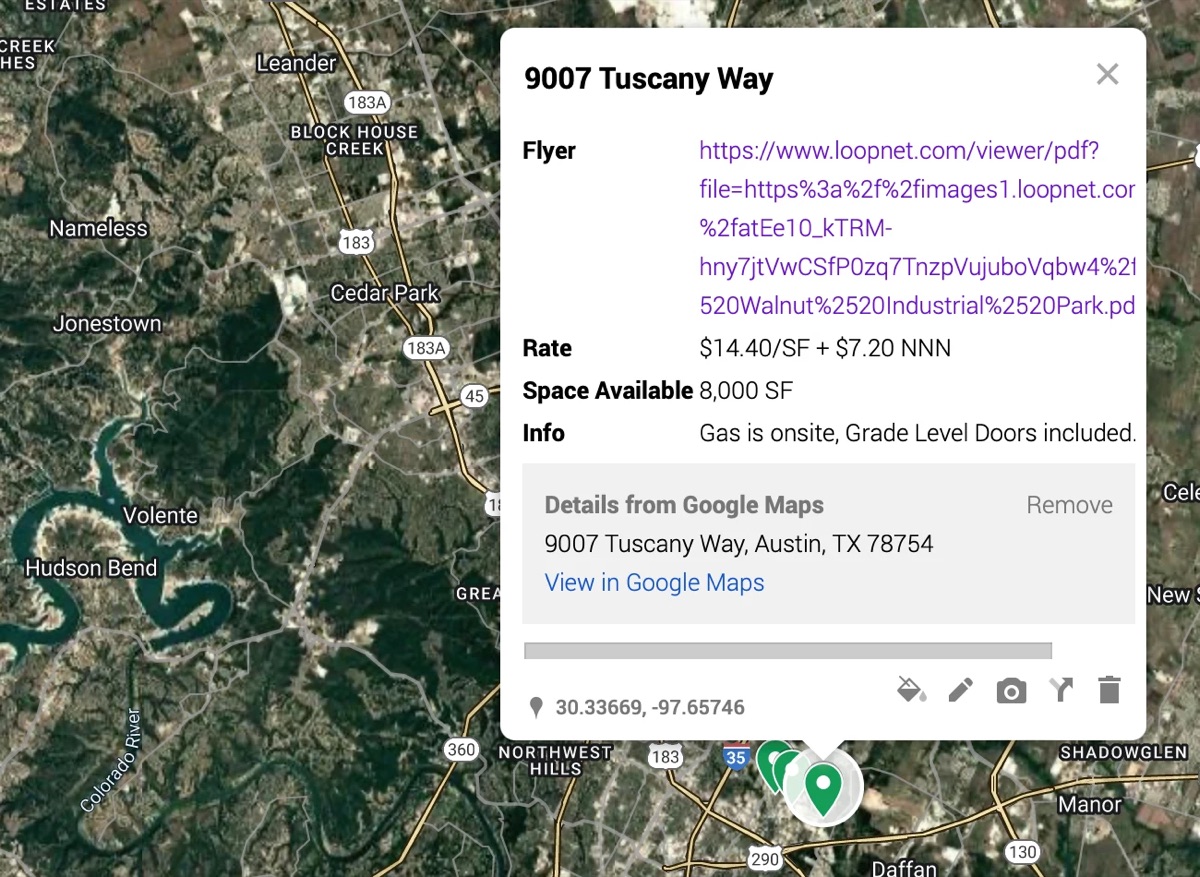
How our industrial process works
- Requirements. We document size, clear height, loading, power, yard, budget, and timing.
- Market survey. We find every option that fits, including space coming available soon, and compile a site report with specs and maps.
- Tours. We tour the short list with you and check each building’s physical specs against your needs.
- Negotiation. We request proposals on the top 1 to 3 sites so landlords compete, then negotiate rent, improvements, free rent, and maintenance responsibilities.
- Lease or purchase. We review the lease with you and your attorney through signing, or manage the purchase contract, due diligence, and closing.
See tenant and buyer representation for more on how we work for you.
What it costs
Tenants and buyers usually pay nothing for representation because the landlord or seller pays our fee. Owners who list industrial property with us pay a commission set in the listing agreement, due at lease signing or closing.
Contact us or call 512-580-7800 to start a search.
Other property types: retail, office, medical, and specialty property.
FAQ
Frequently asked questions
How long does it take to lease warehouse space in Austin?
Many industrial spaces are close to move-in ready. Plan on about a month to search, a month to negotiate, and a couple of months to move in. If the space needs build-out, add roughly 3 to 4 months.
What is the difference between flex and warehouse space?
Flex space combines a larger share of office with some warehouse, usually with grade-level doors and lower ceilings. Bulk and distribution warehouses have higher clear heights, dock-high loading, and truck courts for tractor-trailers.
Are industrial leases in Austin usually NNN?
Yes. Most Austin industrial space is leased NNN, so the tenant pays base rent plus its share of taxes, insurance, and maintenance. We compare total occupancy cost across options.
Who pays the broker on an industrial lease?
In most Austin industrial leases and sales the landlord or seller pays the commission, so tenants and buyers pay nothing for representation.
Can you lease or sell my industrial building?
Yes. We represent owners of warehouse, flex, and small industrial properties who want to lease or sell. See our landlord representation page.
Keep exploring
Industrial by area
Areas we cover
Guides and tools